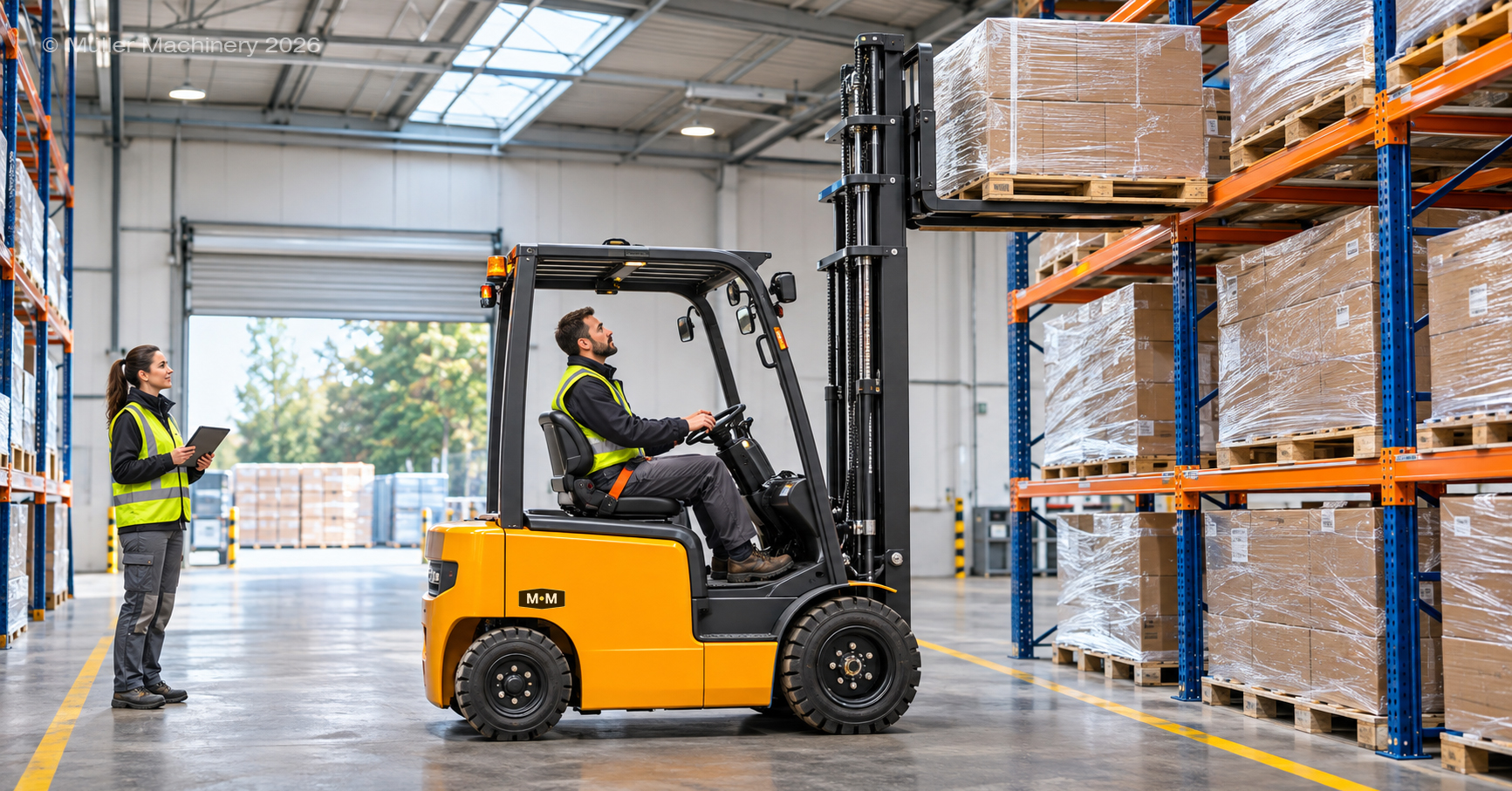
How to choose a forklift for high racking: work out lift height, residual capacity and mast type, with a worked example for 4.2 m racking. Reading time: approx. 8 minutes
Tuesday, 7:40 am. Hannah runs the warehouse at a plumbing and heating wholesaler, and she is standing under a brand-new run of racking, looking up. The top beam sits at 4,200 mm and her current truck stops at 3,000 mm, so for now the top level is a very expensive shelf for dust. She needs to choose a forklift for high racking, and she wants the mast, the capacity and the lift height to match her racks, not just the spec table in a quote. We will work through it with her step by step, so you can drop in your own numbers.
In short: The lift height you need is the height of your top beam plus about 200 mm of clearance to place the pallet. Check capacity on the load chart for your real height and your real load centre (that is residual capacity), not only the rated figure. A mast has to work in two directions: extended, it must reach the top beam, and lowered, it must fit under your lowest door. A counterbalance forklift with a 4,500–4,800 mm triplex mast handles racking up to roughly 4.5 m. Higher than that, or in aisles narrower than about 3.5–4 m, you are in reach truck territory.
What counts as high racking, and where does a counterbalance forklift stop?
For a counterbalance forklift, the kind you see on most loading docks, high racking usually ends somewhere around 4.5–6 m. Above that, and in narrow aisles, the job belongs to reach trucks. They are two different tools, and it helps to settle which one you need before comparing models.
| Criterion | Counterbalance forklift | Reach truck |
|---|---|---|
| Typical lift height | 3–6 m | 8–12 m |
| Working aisle | approx. 4.0–4.5 m | approx. 2.7–3.0 m |
| Dock, yard, unloading lorries | yes | mostly not, smooth floors |
| Role in the warehouse | all-rounder | racking specialist |
These figures are indicative and depend on the model. Hannah's top beam is at 4,200 mm, her aisles are 4.3 m wide, and the same truck has to unload a delivery in the yard every morning. That is a job for a counterbalance forklift with a taller mast. If her racking were 7 m high, this article would end here with "you need a reach truck", and that would be the honest answer.
What lift height does a forklift for high racking need?
Work out lift height like this: top beam height plus about 200 mm of clearance. The pallet has to clear the beam before it can settle on it, and the floor and mast deflection always take a few centimetres.
- Hannah's top beam: 4,200 mm.
- Clearance to place the pallet: + 200 mm.
- Lift height needed: 4,400 mm.
A 4,500 mm mast leaves 100 mm in reserve, which is cutting it fine. A 4,800 mm mast leaves 400 mm and a calm operator when a pallet arrives slightly out of square. Hannah writes down 4,800 mm.
Which mast should you choose? The door and the ceiling matter too
Three mast dimensions decide whether the truck can get into the building at all: lowered height, extended height and free lift. A triplex mast (three sections that slide inside one another) reaches higher for the same lowered height, which makes it the sensible choice for most racking above 3 m.
| Parameter | 3,000 mm mast (MFE 15) | 4,800 mm triplex (Tailift FBD25) |
|---|---|---|
| Lift height | 3,000 mm | 4,800 mm |
| Mast lowered | 2,030 mm | 2,200 mm |
| Mast extended | 4,055 mm | 6,020 mm |
| Top beam at 4,200 mm | out of reach | in reach, 400 mm spare |
The lowered height differs by only 170 mm, while the reach differs by 1,800 mm. Hannah's door is 2,500 mm high, so a 2,200 mm mast passes with 300 mm to spare. Her lights hang at 6,500 mm and the mast is 6,020 mm at full extension, so that fits as well. And yes, we know: the door usually gets measured once the truck is already waiting outside it on a low-loader.
Free lift is how far you can raise the forks before the mast starts to grow. On the Tailift FBD25 it is 945 mm. It earns its keep in containers, trailers and under mezzanines, wherever the ceiling is lower than the load would like.
How much can it lift at height? Rated capacity vs residual capacity
Rated capacity is the load a truck can lift under the conditions on its plate, usually at a 500 mm load centre. Residual capacity is what it can lift safely in your conditions: at your height, with your mast, your attachments and your load. On the top beam, only the second number counts.
Two things reduce capacity. The first is the load centre. Hannah's heaviest pallet weighs 1,400 kg, and a 800 × 1,200 mm Euro pallet picked up from its short side has its load centre at 600 mm, not 500 mm. A rough formula:
capacity at the new load centre ≈ rated capacity × (x + 500) / (x + new load centre), where x is the distance from the front axle to the fork face.
- For the Tailift FBD25: rated capacity 2,500 kg, x = 475 mm.
- 2,500 × (475 + 500) / (475 + 600) = 2,500 × 975 / 1,075.
- Result: approx. 2,270 kg at a 600 mm load centre.
The second is height, mast type and attachments. The product pages in our own range show how much that takes:
| Model | 3.0 m duplex, no sideshift | Triplex with sideshift | Difference |
|---|---|---|---|
| Tailift PFD30 | 3,000 kg | 2,650 kg (4.5 m) | approx. −12% |
| Tailift PFD35 | 3,500 kg | 3,000 kg (4.5 m) | approx. −14% |
| Tailift PFD45 | 4,500 kg | 4,100 kg (4.8 m) | approx. −9% |
Hannah plays it safe and takes another 14% off her result: 2,270 kg × 0.86 gives approx. 1,950 kg. Her heaviest pallet weighs 1,400 kg, which leaves about 550 kg in hand. This is an estimate with stated assumptions, and the load chart of the actual truck is what counts. For comparison, a 1.5 t truck loses about 10% at a 600 mm load centre and is left with roughly 1,350 kg, less than the pallet weighs before the forks have even started to rise.
If you are looking at a second-hand truck instead of a new one, the load chart and the capacity plate are the first things to ask the seller for. The rest of the list is in our guide on what to check when choosing between a new and a used forklift.
With the numbers in place, here is what a truck like that looks like in our range.
Example from our range
Tailift FBD25 Li-Ion (FBD25-4.800)
A 2.5 t electric counterbalance forklift with a 4,800 mm triplex mast: it reaches a 4,200 mm beam with 400 mm to spare and fits under a 2,500 mm door.
| Capacity / load centre | 2,500 kg / 500 mm |
| Drive | electric, Li-Ion 80 V / 280 Ah, no exhaust |
| Lift height | triplex 4,800 mm, free lift 945 mm |
| Mast lowered / extended | 2,200 mm / 6,020 mm |
| Working aisle | 4,000 mm (800 × 1,000 pallet) / 4,200 mm (800 × 1,200) |
Hannah runs a single shift, with a coffee break and long gaps between deliveries. Whether a lithium battery pays off at that rhythm is a calculation of its own, and we cover it in our article on whether a lithium-ion battery makes sense for a forklift used a few hours a day.
Common mistakes when choosing a forklift for high racking
- Lift height equal to beam height. Without 200 mm of clearance, the pallet cannot pass over the beam.
- Measuring the racks but not the door. The lowered mast has to fit under the lowest obstacle on the route, sprinkler pipes included.
- Reading only the rated capacity. On the top level, the load chart applies, not the number in the model name.
- Adding attachments after purchase. A fork positioner or longer forks change the residual capacity and call for a new load chart.
- Measuring the aisle from upright to upright. What counts is the distance between pallets, including their overhang.
Placing 1,400 kg at 4.4 m also takes a practised operator. At Müller Academy we train forklift operators in safe and economical working, on your site or at our hubs. Operator licensing rules differ from country to country, so check what applies where you work.
Decision cheat sheet: which mast for which beam?
| If… | then… |
|---|---|
| top beam up to approx. 2.8 m | a 3,000 mm mast is enough |
| top beam 2.8–4.3 m | 4,500 mm triplex |
| top beam 4.3–4.6 m | 4,800 mm triplex |
| top beam above 4.6 m or aisle under approx. 3.5 m | talk about a reach truck |
| door lower than lowered mast + 100 mm | a different mast or a different route |
| load deeper than 1,000 mm | recalculate capacity for the new load centre |
Take six numbers to your supplier: the height of your top beam, the height of your lowest door, the clear height under lights or sprinklers, the aisle width between pallets, the weight of your heaviest pallet and its depth along the forks.
FAQ
How much lift height clearance do I need above the top beam?
Allow about 200 mm. That is usually enough for the pallet to clear the beam despite an uneven floor and mast deflection. With 100 mm you are cutting it fine.
What is the difference between rated and residual capacity?
Rated capacity applies under the conditions on the plate, usually a 500 mm load centre and a standard mast. Residual capacity takes into account your actual height, mast, attachments and load centre. You read it from the load chart of the specific truck.
What is free lift and when do I need it?
Free lift is how far the forks can rise without the mast getting taller. You need it in containers, trailers, under mezzanines and in low passageways.
Can a counterbalance forklift serve racking of 6 m or more?
Usually it is not the right tool. At those heights and in narrow aisles a reach truck, which typically reaches 8–12 m, does the job better. A counterbalance forklift with a 4,500–4,800 mm triplex mast suits racking up to roughly 4.5 m.
Does a forklift operator need a licence or certificate?
In most countries, yes: operators need documented training and the employer's authorisation, and the trucks need regular inspections. The details differ by country, so check the rules that apply where you work.
And Hannah?
She chose a 2.5 t truck with a 4,800 mm triplex mast, measured the door before delivery (2,500 mm, as expected) and asked for the load chart with sideshift. The top level of her racking has stopped collecting dust. If you are not sure which mast and capacity fit your racks, write to us with your six numbers. You will hear from someone who knows these trucks from the warehouse floor, and if the answer is a reach truck, we will tell you that too.
Thank you for sticking with us through beams, masts and load centres all the way to this paragraph. You will find every forklift, excavator, loader and trailer in the full Müller Machinery range. Come and see us on our LinkedIn page as well, where we share new arrivals, practical tips and a look behind the scenes.